
NANOSATORE
From NANOscale to SATellite detection of ORE halos
The project
NANOSATORE is a two-year research project funded by the Department of Earth System Sciences and Environmental Technologies (DSSTTA) of the Italian National Research Council (CNR). Led by the CNR Institute of Geosciences and Georesources, in collaboration with the CNR Institute of Atmospheric Pollution Research and the Department of Earth Sciences at the University of Pisa, the project aims to establish the scientific foundations for discovering concealed deposits of critical raw materials (CRMs) through their hydrothermal alteration halos.
Hydrothermal ore deposits often occupy relatively small volumes compared with the much larger regions of surrounding rock affected by hydrothermal alteration. During ore formation, circulating fluids redistribute elements, modifying the mineralogical and chemical composition of the host rocks while concentrating economically valuable elements in mineralised zones. These processes generate extensive alteration halos that may provide more readily detectable signatures of concealed mineralisation than the ore bodies themselves.
NANOSATORE aims to establish hydrothermal alteration halos as exploration tools for critical raw material deposits by identifying their diagnostic mineralogical, geochemical, isotopic and spectral fingerprints.
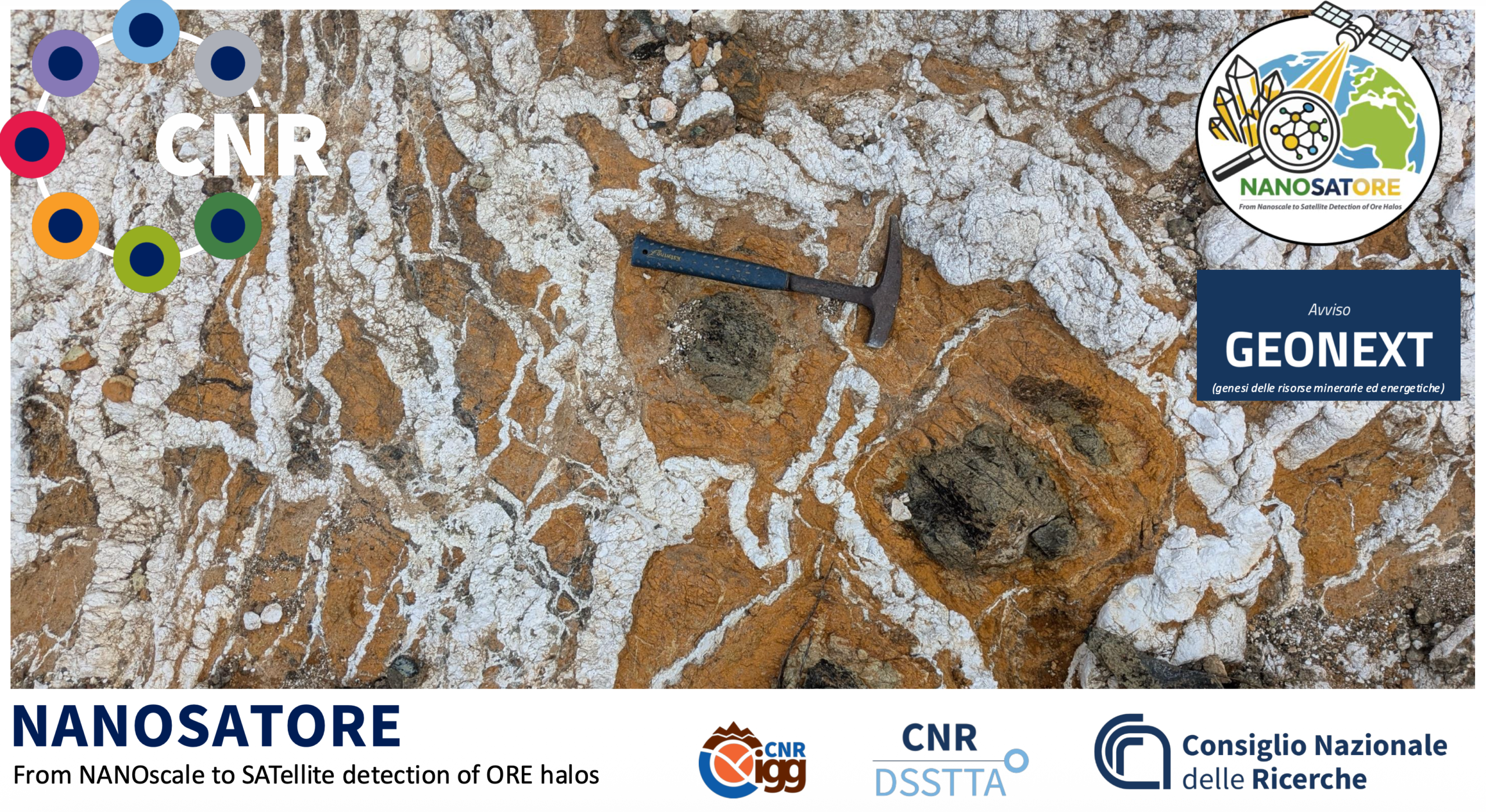
The project focuses on magnesite deposits, an important source of magnesium, which is classified as a critical raw material by the European Union. Using the Castiglioncello magnesite deposit in Tuscany as a natural laboratory, NANOSATORE investigates how alteration signatures develop from the nanoscale to the deposit scale and how they can be recognised through drone- and satellite-based hyperspectral imaging.
Building on the scientific foundations established by the STORECO2 project, NANOSATORE extends this research to greater analytical detail and across multiple spatial scales. The diagnostic features identified at Castiglioncello will subsequently be tested in prospective areas in Greece and Mongolia to assess their potential for guiding mineral exploration.
Scientific approach
Characterise mineralogical, chemical and isotopic changes across hydrothermal alteration halos, from bulk-rock composition to atomic-scale mineral structures
01 — Identify the fingerprints
Characterise mineralogical, chemical and isotopic changes across hydrothermal alteration halos, from bulk-rock composition to atomic-scale mineral structures.
02 — Detect them from above
Translate diagnostic alteration features into hyperspectral signatures and evaluate their detectability using laboratory spectroscopy, drones and satellite imagery
03 — Test new targets
Integrate these observations into a multiscale exploration workflow and test its ability to identify prospective mineralisation in previously unexplored areas.
The natural laboratories
Castiglioncello, Tuscany, Italy – Understanding the fingerprints of mineralisation
The Castiglioncello magnesite deposit, hosted in the Ligurian ophiolites, provides an exceptional natural laboratory for investigating hydrothermal alteration. Here, the transition from unaltered serpentinite through the alteration halo to magnesite mineralisation can be studied directly NANOSATORE uses this geological system to establish diagnostic mineralogical, geochemical and isotopic signatures and investigate how they can be recognised through hyperspectral imaging.
Greece and Mongolia — Testing the exploration workflow
The project will test the exploration workflow in prospective ultramafic terrains in Greece and Mongolia. Starting with satellite-based regional screening, the team will progressively refine selected targets through drone surveys, geological mapping and laboratory analyses. This approach will provide a proof of concept for translating laboratory-derived alteration fingerprints into a practical mineral exploration strategy.
Beyond mineral exploration
Although NANOSATORE focuses on magnesium deposits hosted in ultramafic rocks, its scientific framework is designed to be transferable to other hydrothermal systems associated with critical raw materials. The project will also advance our understanding of fluid–rock interactions, mineral transformations and natural carbon mineralisation. Magnesite deposits represent natural examples of long-term CO₂ storage in carbonate minerals, linking mineral resource exploration to broader questions about Earth’s carbon cycle and geological carbon sequestration
Research team
Institute of Geoscience, National Research Council of Italy (CNR):
- Andrea Rielli — Principal Investigator
- Ilaria Baneschi
- Chiara Boschi
- Andrea Dini
- Simone Vezzoni
- Andrea Berton
Institute for atmospheric pollution, National Research Council of Italy (CNR):
- Alessandro Mei
- Maria Adamo
Earth Science department, University of Pisa (UNIPI):
- Enrico Mugnaioli
- Konstantinos Mavrogonatos
For further information, please contact: andrea.rielli@cnr.it